MonMon / Website planning
Small Hotel and Travel Websites: Help Guests Enquire with Confidence
MonMon AI · Published
A guest deciding on a room or a trip needs practical information as well as attractive photographs. A useful travel website helps the visitor understand the offer, compare relevant options and ask about dates. Its wording should also make clear whether the website provides a booking request or a system that confirms availability.
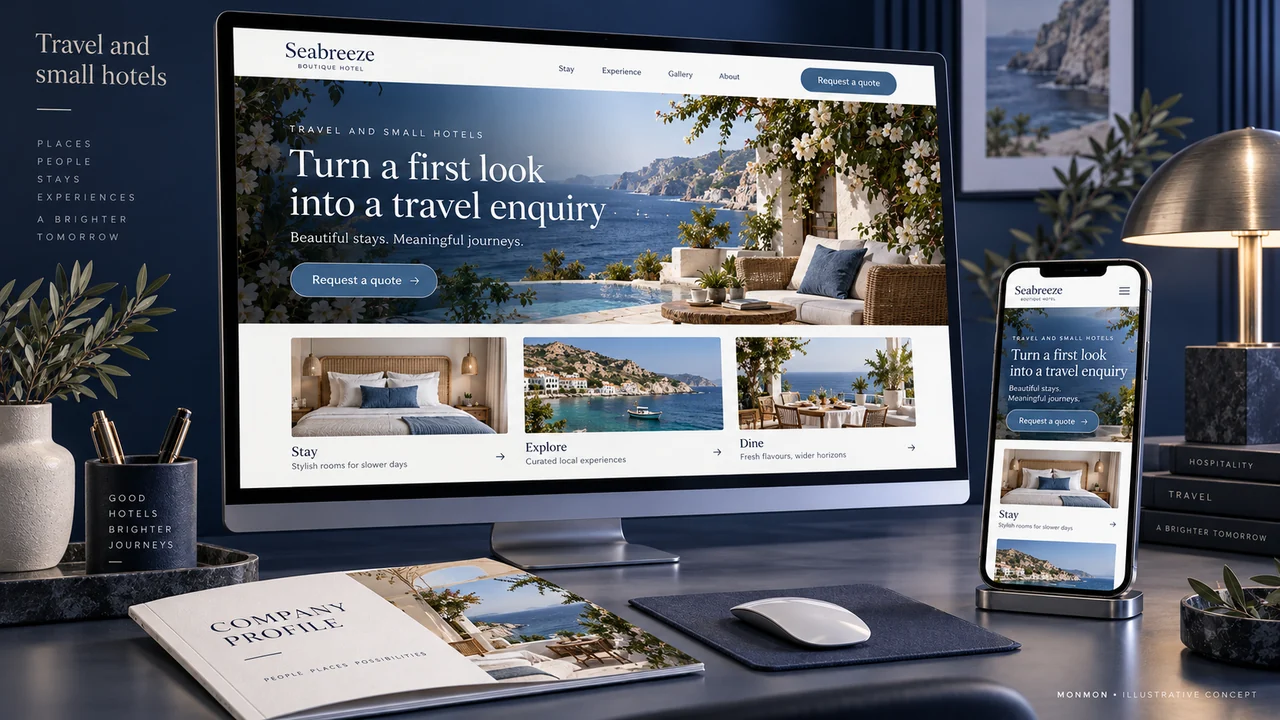
Build room or tour pages around the actual offer
For accommodation, use approved room names, occupancy details, facilities and images that match the room type. For tours, explain the itinerary and the inclusions the business has approved. Do not combine several options in a way that implies every feature is included in every offer. A clear description helps the guest choose the correct enquiry.
Make location and practical details easy to find
Provide the accurate location and appropriate directions or map link. Publish the check-in, meeting-point or other practical information relevant to the offer. Keep changing information under an assigned owner. Where a detail depends on dates or an individual arrangement, tell the visitor how it will be confirmed instead of presenting a permanent promise.
Use photographs and captions together
Identify the room, common area, destination or experience shown. Distinguish actual photographs from illustrations and representative concepts. A guest should not need to infer which room a photograph belongs to. Review the gallery on mobile, where a long set of large images can make practical information harder to reach if the page is poorly organised.
Define the reservation process
A first enquiry may ask for the intended dates, number of guests, selected room or tour and a contact method. Say how confirmation happens. Live inventory, payment, cancellations and third-party booking connections are functions to specify individually. Do not describe a presentation website as a complete reservation platform if those processes are not included.
Check consistency before accepting the website
Compare online information with the owner-approved offer and any downloadable presentation. Test the journey from selecting a room or tour to receiving the enquiry. Verify contact links and maps on a phone. After launch, distinguish enquiries, quotations and confirmed bookings when reviewing performance. An appealing gallery alone does not establish occupancy or booking growth.
Your preparation checklist
- Room or tour names consistent
- Inclusions accurately described
- Images identify the option shown
- Practical details approved and maintained
- Request separated from confirmed booking
- Integrations explicitly scoped
Frequently asked questions
Can a small hotel launch with enquiry-only booking?
Yes, if the site clearly explains that staff must confirm availability and reservation details.
Are online payments automatically part of a travel website?
No. Payment and booking integrations must be specified and connected to the business’s actual processes.